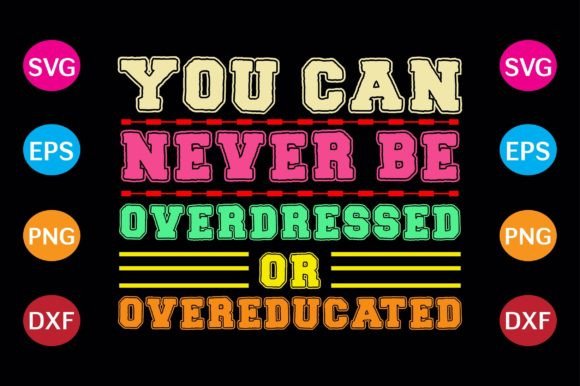
You Can Never Be Overdressed or Overeducated
“You Can Never Be Overdressed or Overeducated” is a phrase rooted in wit, intellectual tradition, and quiet confidence. Attributed to writer Oscar Wilde—and later echoed by scholars, educators, and cultural commentators—it carries layered meaning: that refinement in appearance and depth in learning are not excesses, but expressions of respect—for oneself, for others, and for the occasion. In today’s context, it has evolved into more than a motto. It’s a design concept, a statement of values, and a versatile visual motif—especially popular on back-to-school apparel.
What Makes This Design Distinct?
Unlike generic school-themed graphics (think apples, pencils, or cartoon graduation caps), You Can Never Be Overdressed or Overeducated stands out through tone and texture. It avoids childishness or cliché, opting instead for understated sophistication. The phrasing invites reflection—not just recognition. Visually, it works across styles: minimalist typography, vintage serif treatments, subtle monochrome palettes, or even playful script variations. Its strength lies in duality: it reads as both aspirational and grounded, scholarly yet stylish.
This isn’t just text on a shirt. It functions as a quiet signal—telling peers, professors, or parents that the wearer values intentionality: in how they present themselves, and how they approach learning. That resonance matters, especially for adults returning to education, graduate students, instructors, or professionals pursuing certifications. It bridges identity and purpose without leaning into irony or sarcasm.
How It Fits Within Broader Back-to-School Design Categories
Back-to-school T-shirt designs generally fall into three overlapping categories:
- Literal/Functional: “Class of 2025,” “Biology Major,” “Future Nurse.” These prioritize clarity and affiliation. They’re useful for orientation, group identification, or departmental pride—but often lack longevity beyond the semester.
- Playful/Ironic: “I Survived Organic Chemistry,” “Caffeine & Chaos,” “My GPA Is a Work in Progress.” These rely on shared struggle and humor. They build camaraderie but may feel dated quickly or unintentionally undermine academic seriousness.
- Values-Driven: “Curiosity Required,” “Question Everything,” You Can Never Be Overdressed or Overeducated. These emphasize mindset over milestone. They age well, cross disciplines, and speak to lifelong learning—not just enrollment status.
Compared to the first two, You Can Never Be Overdressed or Overeducated occupies a narrower but more durable niche. It doesn’t promise laughs or instant recognition—it invites alignment. That makes it less universal, but more meaningful for those who choose it deliberately.
Strengths and Practical Tradeoffs
The design’s primary strength is its adaptability across contexts. A student wearing it to a campus lecture series, a faculty member at a conference, or a working adult attending evening classes—all read as intentional, not costumed. It avoids seasonal obsolescence: unlike “First Day of Fall Semester” shirts, it remains relevant year after year.
However, this same strength introduces tradeoffs. Because it leans into nuance rather than immediacy, it may not resonate with younger audiences seeking bold, trend-forward visuals—or with institutions preferring branded, logo-centric merchandising. It also assumes a baseline familiarity with the phrase’s origin and connotation. Someone unfamiliar with Wilde—or skeptical of aesthetic formality—might misread it as elitist or pretentious, despite its inclusive intent.
Typography and execution matter significantly here. A poorly kerned, overly ornate font can tip the balance from elegant to fussy. Likewise, pairing the phrase with inappropriate imagery (e.g., glitter, cartoon crowns, or excessive embellishment) dilutes its gravitas. The most effective versions treat the words as the sole focal point—clean, legible, and proportionally balanced.
When This Design Is the Right Choice
You Can Never Be Overdressed or Overeducated fits best when authenticity, continuity, and quiet confidence are priorities. Consider it if:
- You’re an adult learner re-entering education after years in the workforce—and want apparel that reflects your maturity and commitment, not nostalgia.
- You teach, advise, or support students and wish to model intellectual curiosity without lecturing.
- You value design longevity: you prefer one thoughtful shirt over several seasonal ones.
- Your environment embraces subtlety—small liberal arts colleges, graduate seminars, professional development cohorts, or creative fields where personal expression aligns with professionalism.
It also suits hybrid or remote learners who still want tangible connection to their academic identity—even if their “classroom” is a home office or coffee shop. Wearing it signals presence, not performance.
When Another Option Might Serve Better
This phrase isn’t ideal for every situation. If your goal is immediate visibility or team cohesion—say, for a high school orientation event or a university-wide spirit day—a more direct, logo-based, or color-coordinated design may communicate faster and more uniformly.
Similarly, if your audience includes many first-generation students or learners from backgrounds where formal education carries complex emotional weight, a phrase steeped in literary tradition may unintentionally feel distant or inaccessible. In those cases, inclusive, action-oriented language (“Keep Learning,” “Every Question Counts,” “We Grow Together”) might foster broader connection.
Also consider production context. While the phrase translates well to print, embroidery, or vinyl cut, it requires careful spacing and sizing—especially in SVG or DXF formats—due to its length and rhythmic cadence. Shorter slogans lend themselves more easily to small-format applications like tote bags or lapel pins.
Digital File Considerations: What the ZIP Includes—and Why It Matters
The digital download—delivered as a ZIP file containing SVG, DXF, EPS, and high-resolution PNG files—addresses practical needs across user types. Each format serves a distinct workflow:
- SVG is ideal for web use, Cricut, Silhouette Studio, and modern vector editors. It scales infinitely without quality loss and supports transparency.
- DXF is essential for CNC machines and certain laser cutters—common in makerspaces or small-batch apparel shops.
- EPS remains widely compatible with older Adobe Illustrator versions and commercial print providers requiring legacy vector standards.
- PNG offers ready-to-print raster flexibility—useful for mockups, presentations, or platforms that don’t accept vector uploads.
Having all four formats means no single user is locked out due to software constraints. Whether you’re using free tools like Inkscape, subscription-based Adobe apps, or hardware-specific cutting software, the files adapt. That level of technical inclusivity supports real-world usability—not just theoretical appeal.
Making an Informed Choice
Selecting a back-to-school design involves more than aesthetics. It’s about alignment: with your values, your role, your environment, and your long-term relationship to learning. You Can Never Be Overdressed or Overeducated excels when that alignment centers on dignity, intention, and enduring relevance.
But it’s not the only valid path. Some need immediacy. Others prioritize accessibility. Still others seek community through shared humor or institutional pride. There’s no hierarchy—only fit. Evaluate what the phrase communicates *to you*, how it will be received *where you’ll wear it*, and whether the included file formats match your intended production method.
Ultimately, the right choice isn’t the most popular or the most clever—it’s the one that feels true, wears well, and holds up across semesters, roles, and seasons.