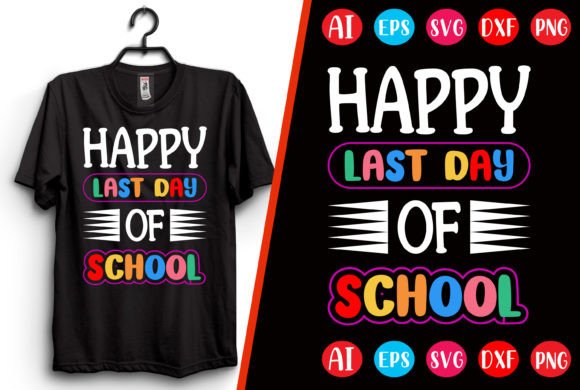
Happy Last Day of School T-Shirt Design: A Versatile Digital Asset for Educators, Creators, and Small Businesses
As the academic year winds down, educators, school staff, PTA organizers, camp directors, and small business owners often seek meaningful, lighthearted ways to commemorate student achievement and transition into summer. The Happy Last Day of School T-shirt Design meets this need—not as a generic clipart download, but as a professionally crafted, production-ready digital asset built for flexibility, scalability, and real-world use. Unlike static graphics found on free design platforms, this file set is engineered for both creative control and immediate deployment—whether printed on cotton tees for a fifth-grade farewell picnic or adapted for tote bags promoting a summer enrichment program.
Why This Design Serves Multiple Roles Beyond a Simple Graphic
A Happy Last Day of School T-shirt Design isn’t just about nostalgia or seasonal timing—it’s a functional communication tool. Its value emerges in how it bridges intention and execution across diverse contexts. For instance, a middle school counselor might use the design to reinforce positive closure after a challenging year; a local print shop owner could integrate it into a “Back to School Prep” bundle offered to teachers in July; a homeschool co-op leader may customize colors to match their group’s branding before ordering 30 shirts for an end-of-year field day.
What makes this particular iteration especially useful is its intentional technical architecture: the inclusion of AI, EPS, SVG, DXF, and high-resolution PNG formats means the same core artwork behaves predictably whether imported into Adobe Illustrator for vector editing, Cricut Design Space for vinyl cutting, Silhouette Studio for heat-transfer projects, or Canva for quick social media promotion. That cross-platform compatibility eliminates format-related roadblocks common with low-fidelity downloads.
Technical Specifications Designed for Real-World Production
The file package delivers practical utility through precise technical choices:
- Print-Ready Resolution: At 4500×5400 pixels, the raster assets support crisp output on standard garment sizes—including oversized tees and youth smalls—without pixelation or interpolation artifacts.
- Color Mode Consistency: All vector files are delivered in RGB, aligning with screen-based workflows used by most independent designers and small studios. While CMYK conversion remains necessary for commercial offset printing, RGB ensures accurate previewing and editing across devices.
- Layered Flexibility: Because the design is fully editable—not flattened or rasterized—users can isolate text elements, adjust spacing between “Happy” and “Last Day,” or swap out sun icons for graduation caps without compromising quality.
- Transparency Support: The included PNG uses alpha transparency, enabling seamless layering over photos, textured backgrounds, or gradient overlays—ideal for mockup creation or digital campaign assets.
This attention to technical detail reflects an understanding that users aren’t just downloading art—they’re integrating a component into larger systems: inventory management tools, POD (print-on-demand) dashboards, classroom supply budgets, or event planning timelines.
Adaptability Across User Groups and Use Cases
Different professionals interact with the Happy Last Day of School T-shirt Design in distinct ways—each revealing a facet of its utility.
Educators and School Administrators
Teachers frequently curate class traditions around milestones. Rather than sourcing disparate elements from multiple sites, they can modify color schemes to reflect school colors (e.g., navy and gold), add grade-level identifiers (“Class of 2024”), or embed staff appreciation messaging (“Thanks, Ms. Lee!”). The ease of modification supports inclusive practices—adjusting font weight for readability, increasing contrast for students with visual processing differences, or simplifying iconography for younger grades.
Small Business Owners and Print Providers
Local apparel shops, screen printers, and embroidery services benefit from time savings and reduced revision cycles. With ready-to-cut DXF files, a vinyl cutter operator avoids redrawing outlines manually. An embroidery digitizer can import the SVG to trace clean paths for stitch programming. And because the design scales infinitely in vector form, one file serves everything from pocket-sized patches to full-back prints—no need to maintain separate versions.
Content Creators and Educational Entrepreneurs
YouTube educators, curriculum developers, and EdTech founders use such assets to build brand cohesion. A science educator launching a summer STEM camp might rebrand the design with rocket icons and “Mission Complete!” while preserving layout integrity. Similarly, a podcast host covering K–12 education policy could license the base graphic, then overlay custom typography for episode merch—leveraging the same foundational structure to maintain visual continuity across seasons.
Design Philosophy Embedded in Practical Features
The phrase “Welcome to my shop. Back To School T-shirt Design” signals more than marketing copy—it points to a creator mindset grounded in accessibility and empowerment. This isn’t a locked template requiring proprietary software or subscription access. It’s a self-contained ZIP folder containing open-standard formats usable across operating systems and price points.
Consider the implications of including both AI and SVG files. Adobe Illustrator remains industry standard for professional print prep, yet many educators and hobbyists rely on browser-based tools like Inkscape or Figma—both of which natively support SVG. By delivering both, the creator acknowledges varying levels of technical fluency and resource constraints. Likewise, DXF inclusion speaks directly to makerspaces, vocational programs, and DIY communities where CNC routers and laser cutters are increasingly common in learning environments.
Real-World Considerations When Implementing the Design
While the file set offers significant advantages, thoughtful implementation requires awareness of contextual factors:
- Garment Selection Impacts Visual Outcome: A vibrant yellow background works beautifully on charcoal tees but may wash out on heather grey. Users should test color combinations using the editable layers before finalizing bulk orders.
- Print Method Determines Format Priority: Screen printers typically prefer vector paths (AI/EPS), while direct-to-garment (DTG) operators often request high-DPI PNGs with transparent backgrounds. Knowing your printer’s preference streamlines prepress.
- Licensing Clarity Matters: Though not stated explicitly here, responsible use assumes non-exclusive, royalty-free rights for physical products—meaning you may sell shirts bearing the design, but cannot resell the digital files themselves or claim copyright over the original composition.
- Accessibility Extends Beyond Color: When modifying text, ensure sufficient contrast ratios (at least 4.5:1 for normal text) and avoid relying solely on color to convey meaning—important for students with color vision deficiencies or screen reader users viewing related web content.
How “Easy to Modify and Change Color” Translates Into Workflow Efficiency
The promise of easy customization isn’t abstract—it maps directly to time saved and decision fatigue reduced. Imagine a PTA committee meeting where three members propose different color palettes. Instead of waiting 48 hours for a designer to generate options, one member opens the AI file, selects the “Sun” layer, and applies Pantone 123 C in under 90 seconds. Another adjusts stroke width on the banner text to improve legibility at 10-inch print size. A third exports individual elements as SVGs to animate for a Facebook announcement video.
This level of responsiveness transforms the Happy Last Day of School T-shirt Design from passive decoration into an active collaboration tool—one that accommodates consensus-building, iterative feedback, and rapid prototyping without external dependencies.
Connecting to Broader Trends in Educational Merchandising
There’s growing recognition that school-related apparel functions as both memory anchor and community identifier. Research in educational psychology suggests that tangible, shared symbols—like class shirts—strengthen group belonging and reduce summer learning loss anxiety by maintaining continuity between academic years. Meanwhile, small-batch printing technology has lowered barriers to entry: what once required minimum orders of 50+ units now supports runs as small as one—making personalized, milestone-driven designs economically viable for even single-classroom initiatives.
In this context, the Happy Last Day of School T-shirt Design participates in a shift toward human-centered, emotionally intelligent school culture tools—not merely promotional items, but intentional artifacts supporting social-emotional development, identity affirmation, and collective celebration.
Final Thoughts on Integration Over Isolation
Ultimately, the strength of this resource lies not in its standalone appeal, but in how seamlessly it integrates into existing workflows, values, and goals. Whether used to recognize resilience after a disrupted school year, welcome incoming students during orientation week, or simply bring levity to a routine staff meeting—the design succeeds when it fades into the background of purposeful action. Its technical robustness, format diversity, and thoughtful construction allow users to focus less on *how* to make it work and more on *why* it matters—for students, for teams, and for the quiet, cumulative work of building meaningful learning experiences.