30 Trace, Connected the Dot KDP Interior
What if one interior file could anchor multiple high-demand children’s activity books—without redesigning from scratch? 30 Trace, Connected the Dot KDP Interior delivers exactly that: a cohesive, production-ready set of 17 pages designed for creators who value efficiency without sacrificing quality or educational intent. It’s not just another tracing bundle—it’s a strategic asset built for real-world publishing workflows.
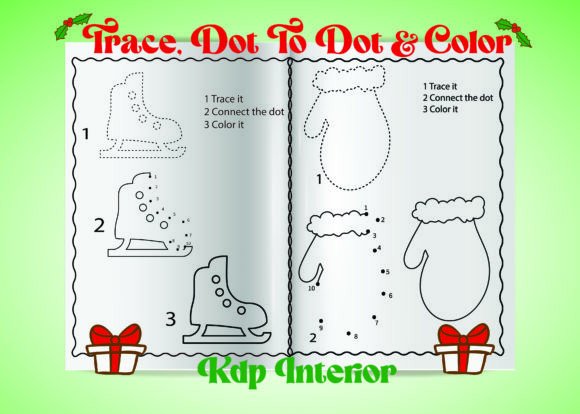
This interior includes 30 distinct tracing and dot-to-dot activities with a warm, festive Christmas theme—think decorated trees, snowmen, candy canes, and wrapped presents—but structured so the seasonal elements support skill development, not distract from it. Each page invites two sequential actions: first, tracing lines, curves, or numbered dots to build pencil control; second, coloring the completed image to reinforce engagement and creative expression. That dual-action design is intentional—and research-backed—for strengthening hand-eye coordination and fine motor foundations in pre-K through early elementary learners.
Why This Interior Fits Real Publishing Needs
Unlike generic clipart packs or fragmented PDFs, this interior was built with KDP’s technical requirements and audience expectations in mind. Every page is sized to 8.5 x 11 inches, bleed-free, and optimized for crisp black-and-white printing—critical for low-cost interior files that still feel premium. The package includes not only the final print-ready PDF but also editable source files: 10 EPS vector files (ideal for resizing without quality loss), 10 high-res PNGs (for digital previews or social thumbnails), and 10 JPGs (for quick web use or email samples). That flexibility means you’re never locked into one format—you can adapt, repurpose, or rebrand across projects.
For example, an educator launching a winter-themed classroom resource can extract the dot-to-dot pages for a “Count & Create” math center, then use the traced outlines as stencils for cut-and-paste crafts. A freelance designer building a custom activity book for a local toy store might layer subtle watercolor textures over the included PNGs—keeping the original line work intact while adding brand-aligned warmth. And a small publisher testing niche categories can split the 30 activities across three micro-books: Christmas Tracing for Toddlers, Dot-to-Dot Numbers 1–20, and First Shapes & Curves—each with its own cover and targeted Amazon description.
Creative Adaptations Beyond the Obvious
The strength of 30 Trace, Connected the Dot KDP Interior lies in how easily it supports variation—not repetition. You don’t need to sell “another tracing book.” You can sell:
- A Back-to-School Pen Control Starter Kit, where the Christmas theme becomes optional—swap in autumn leaves or school supplies using the editable EPS layers;
- A Therapy-Ready Fine Motor Workbook for occupational therapists, with added instruction prompts on select pages (e.g., “Start at the star. Trace slowly. Lift your pencil only at the dot.”);
- A Bilingual Tracing Companion, where Spanish or French vocabulary labels are added beside each image (“árbol de Navidad”, “bonhomme de neige”)—leveraging the clean white space around each illustration;
- An Augmented Reality Coloring Experience, using the high-res PNGs as base assets for simple AR triggers (via free tools like Unity Reflect or Adobe Aero) that animate the finished drawing when scanned.
Each adaptation starts from the same foundation—but shifts focus, audience, and value proposition. That’s scalability rooted in utility, not volume.
How to Keep Output Clear, Consistent, and Audience-Friendly
Clarity begins with intentionality—not decoration. When inserting these pages into your own KDP book, resist overloading layouts. Leave margins breathable. Use consistent font pairing (e.g., a rounded sans-serif for instructions, a clean serif for titles) and limit color accents to two tones max if adding design elements. For parents and teachers scanning Amazon listings, clarity means instantly recognizing purpose: “Yes—this builds pencil control,” “Yes—this works for ages 3–6,” “Yes—this prints cleanly on home printers.”
Consistency comes from respecting the interior’s built-in rhythm. Notice how tracing paths progress from straight lines → gentle curves → zigzags → full shapes → numbered sequences. Honor that scaffolding. If you reorder pages, preserve the developmental arc—or clearly label sections by skill level (“Beginner Lines,” “Confident Curves,” “Challenge Sequences”). That transparency builds trust and reduces support requests.
Originality isn’t about reinventing tracing—it’s about framing. Instead of calling it “a fun Christmas activity book,” try “A Pencil Control Progression: From First Lines to Confident Coloring.” That language signals expertise and structure, appealing to educators and detail-oriented buyers—not just casual shoppers.
Practical Next Steps for Creators
If you’re evaluating whether 30 Trace, Connected the Dot KDP Interior fits your goals, ask yourself:
- Do I need reliable, print-tested pages—not just ideas? Yes. These have been validated for KDP’s grayscale rendering and trim tolerance.
- Am I building more than one activity product this season? Yes. Reuse the same interior across formats: spiral-bound teacher edition, downloadable PDF for homeschoolers, or laminated card set (using the EPS files).
- Do I want room to add my voice—not just fill in blanks? Yes. The clean vector art and open composition leave space for your branding, notes, or pedagogical notes without crowding.
This isn’t about finishing faster. It’s about launching smarter—knowing your interior already meets baseline standards for usability, accessibility, and educational alignment. That frees you to focus where you add unique value: your curation, your audience insight, your voice in the description, your marketing angle.
Whether you’re prototyping your first KDP workbook or scaling a catalog of early learning resources, 30 Trace, Connected the Dot KDP Interior works as both foundation and catalyst—practical enough for today’s deadline, flexible enough for next season’s pivot.