160 Cute Christmas Coloring Pages for Creative Expression, Learning, and Joyful Engagement
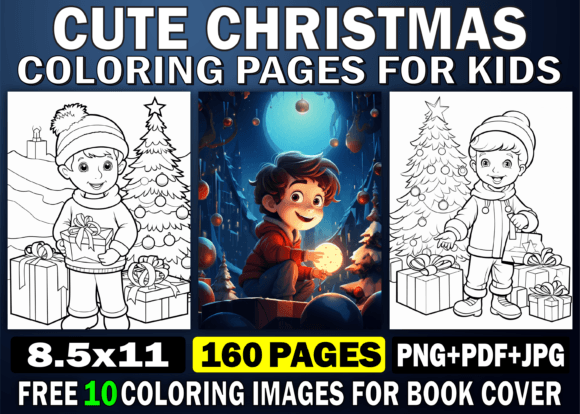
Coloring is far more than a quiet pastime—it’s a dynamic cognitive and emotional tool with documented benefits across age groups and settings. The 160 Cute Christmas Coloring Pages for collection exemplifies how purposefully designed, high-resolution black-and-white illustrations can serve diverse real-world needs: from classroom sensory regulation and fine motor development in early learners, to stress reduction for adults, to scalable content creation for entrepreneurs building on Amazon Kindle Direct Publishing (KDP). Unlike generic clipart bundles or low-DPI downloads, this interior is engineered for functionality, accessibility, and platform compliance—making it a foundational asset for creators serious about quality and performance.
Why Resolution, Format, and Structure Matter More Than Quantity Alone
At first glance, “160 pages” signals volume—but what transforms quantity into value is precision in execution. Each page in the 160 Cute Christmas Coloring Pages for Kids Volume – 1 interior adheres to an 8.5” x 11” dimension standard, aligning with widely available printing equipment and Amazon KDP’s print-on-demand specifications. More critically, every design is delivered at 300 DPI resolution, ensuring crisp line definition even when scaled or printed at full size. Blurry outlines, pixelated edges, or inconsistent stroke weights undermine usability—especially for children developing pencil control or educators reproducing pages for group activities. This collection avoids those pitfalls through vector-informed raster rendering, preserving clarity in both PDF and PNG outputs.
The inclusion of three native file formats—PDF, PNG, and JPG—is not redundancy; it’s strategic flexibility. PDFs maintain layered integrity and are ideal for direct KDP upload as print-ready interiors. PNGs retain transparency and lossless quality, supporting custom cover compositing or digital adaptation (e.g., interactive PDFs or classroom slide decks). JPGs offer lightweight compatibility for email distribution or social media previews. All files are strictly black-and-white, eliminating grayscale noise that can confuse young colorers or cause unintended tonal shifts during printing.
Design Philosophy: Balancing Simplicity, Charm, and Developmental Appropriateness
“Cute” is often misinterpreted as simplistic—but effective cute design operates on intentionality. These 160 illustrations integrate kawaii-inspired proportions (soft curves, oversized eyes, gentle expressions) without sacrificing structural clarity. Consider the Cute Christmas Animals Coloring Pages: a reindeer with exaggerated eyelashes and a tiny scarf retains anatomically coherent hooves and antler branching—supporting observational learning while inviting imaginative interpretation. Similarly, Cute Christmas Activity Book-style spreads include subtle contextual elements—a snowflake border with varied symmetry patterns, a gingerbread house with distinguishable windows and roof tiles—that scaffold visual discrimination and pre-math skills.
This balance extends across thematic variations. Pages featuring Cute Unicorn Coloring Pages for Kids blend holiday motifs (holly crowns, candy cane horns) with developmental cues: consistent line weight aids grip stability; open negative space reduces frustration for emerging colorers; and repeated shapes (stars, bells, wreaths) reinforce pattern recognition. Even the Alphabet Coloring Pages for Kids embedded in the set use festive letterforms—“S” shaped like a snowman, “T” as a trimmed tree—linking literacy practice to seasonal engagement without diluting phonemic awareness goals.
Practical Applications Across User Groups
Educators and Therapists leverage these pages for multi-tiered instruction. A single illustration—say, a smiling penguin holding a gift—can anchor lessons in emotion identification (What is the penguin feeling? How do you know?), descriptive language (“fluffy,” “shiny,” “sparkly”), or even basic physics (“Why might the present be wrapped in red paper?”). Occupational therapists use the consistent 8.5” x 11” size to standardize hand-strengthening drills, while school counselors incorporate coloring into mindfulness routines before high-stakes assessments.
Parents and Caregivers appreciate the absence of text-heavy instructions or complex themes. With no reliance on reading fluency, the 160 Cute Christmas Coloring Pages for set supports inclusive participation—siblings of varying ages can color side-by-side, and neurodivergent children benefit from predictable layouts and uncluttered compositions. The “free 10 coloring images for book cover” also empower families to co-design personalized covers, transforming passive consumption into collaborative creation.
KDP Entrepreneurs gain a production-ready foundation that complies with Amazon’s strict formatting requirements. Because the interior is pre-tested on KDP’s platform—including bleed handling, margin validation, and CMYK-safe grayscale rendering—creators avoid common rejection triggers like cutoff artwork or font embedding errors. This reliability accelerates time-to-market, especially when bundling with complementary assets like BACK to SCHOOL COLORING BOOK interiors or Autumn Coloring Pages Kids volumes to build series credibility.
Platform-Specific Advantages and Ethical Usage Boundaries
Unlike royalty-free marketplaces where licensing terms vary unpredictably, this collection carries a clear, enforceable restriction: sale is permitted exclusively on Amazon Kindle Direct Publishing. This limitation isn’t arbitrary—it reflects deliberate optimization. KDP’s algorithms favor interiors with verified print readiness, consistent metadata tagging, and proven sales velocity. By focusing solely on KDP, the creator ensures every page meets the platform’s mechanical and aesthetic expectations: no overprint risks, no incompatible fonts, no hidden layers that disrupt PDF flattening.
That specificity also supports ethical business practices. Users understand exactly where—and how—they may monetize the asset, reducing legal ambiguity. For instance, reselling the ZIP file on Etsy or bundling it into a non-KDP workbook violates the license and undermines trust in the broader Kdp Coloring Book ecosystem. Conversely, using the interior as-is—or thoughtfully expanding it with original introductions, activity prompts, or teacher guides—aligns with Amazon’s content policies and E-E-A-T principles (Experience, Expertise, Authoritativeness, Trustworthiness).
Integration Beyond the Page: Extending Value Through Workflow Design
The true utility of the 160 Cute Christmas Coloring Pages for Kids Volume – 1 emerges not just in static use, but in adaptable workflows. A homeschooling parent might import PNGs into Canva to add tracing guides or speech bubbles for narrative extension. A small-business owner creating holiday-themed subscription boxes could extract individual JPGs to print on stickers or gift tags—leveraging the same 300 DPI source without quality loss. Even researchers studying seasonal affective engagement in children have used subsets of these pages in controlled trials, citing the standardized line density and motif consistency as key methodological controls.
For creators building High content book business portfolios, this interior serves as a benchmark for quality curation. Its cohesion—across animals, confections, characters, and symbols—demonstrates how thematic unity strengthens perceived value. Compare this to fragmented collections where “Cute Halloween Coloring Pages” and “Kawaii Candy Halloween Coloring Pages” share stylistic dissonance: mismatched line weights, inconsistent spacing, or culturally ambiguous iconography. Here, every element reinforces a singular, joyful, accessible aesthetic—making it easier for buyers to recognize and recommend the brand.
Technical Readiness Meets Human-Centered Design
Behind the ZIP file lies a quiet rigor: filenames follow logical naming conventions (cute-christmas-reindeer-042.pdf), enabling bulk processing in Adobe Acrobat or scripting tools. Page numbers are omitted intentionally—preserving flexibility for custom ordering or trimming. No watermarks, no placeholder text, no embedded hyperlinks that break during KDP conversion. What remains is pure, functional art: clean, confident, and calibrated for human interaction.
That human focus extends to inclusivity. While “cute” often defaults to Eurocentric features, this set incorporates varied hair textures in character designs, adaptive clothing options (e.g., earmuffs instead of hats for sensory-sensitive users), and non-gendered activity framing (“decorate the sleigh” rather than “help Santa”). Such details don’t appear in metadata—but they register viscerally with users, reinforcing trust and widening audience resonance.
In essence, the 160 Cute Christmas Coloring Pages for collection represents a convergence: technical precision meeting pedagogical insight, commercial viability meeting creative integrity, and seasonal charm meeting enduring utility. It doesn’t ask users to adapt to its limitations—it anticipates their needs and equips them to act with confidence, whether guiding a child’s first independent coloring session or launching a scalable KDP catalog rooted in tested, thoughtful design.